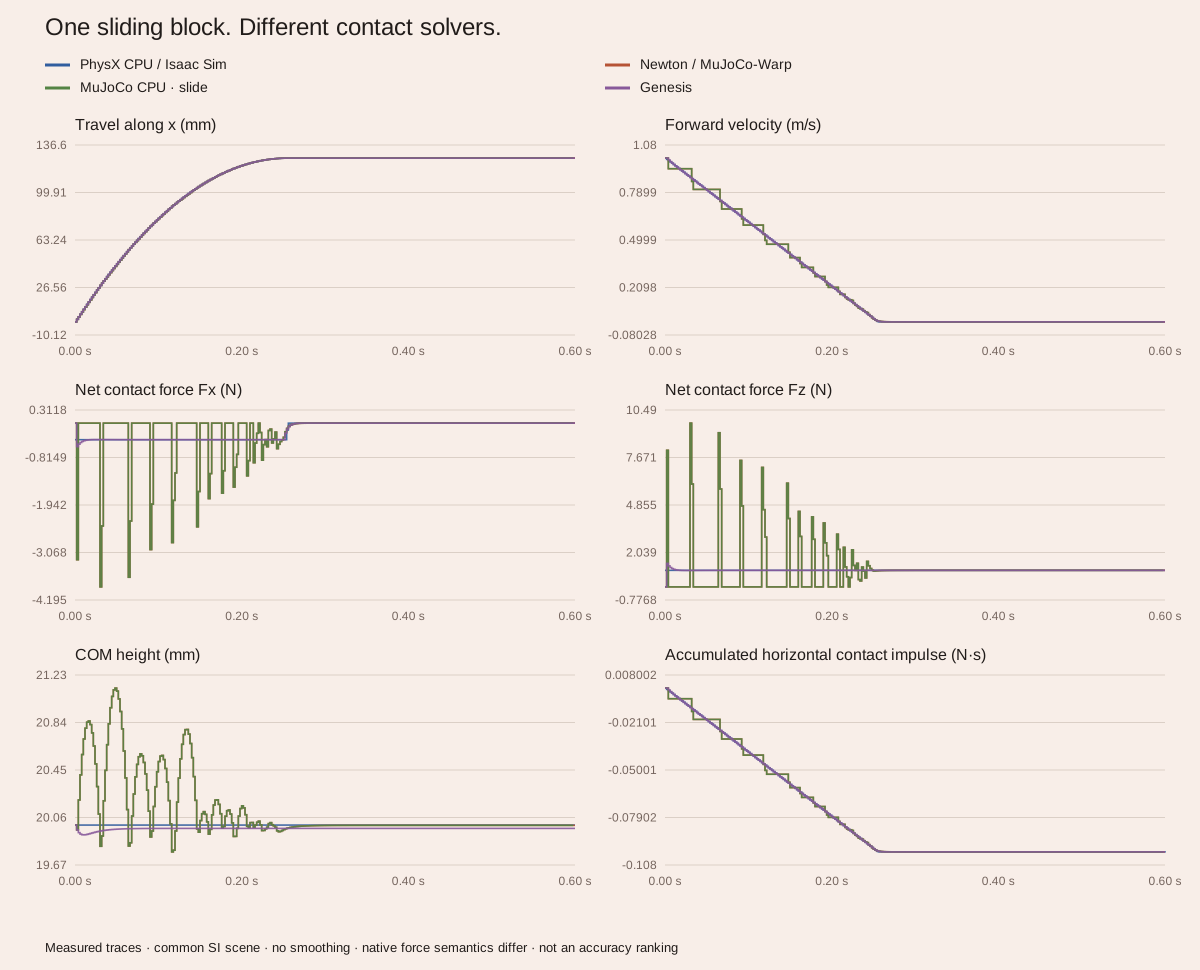
Preliminary diagnostic comparison. Analytic 4 cm cube, 100 g, initial speed 1 m/s, nominal friction 0.4, gravity 9.81 m/s², timestep 2 ms. No robot, controller, damping force or imported mesh.
| Stack | Travel (full recording) | Stays below 1 mm/s (s) | Maximum per-step momentum residual |
|---|---|---|---|
| PhysX CPU / Isaac Sim | 126.422 mm | 0.256 | 6.23e-08 N·s |
| Newton / MuJoCo-Warp | 126.472 mm | 0.266 | 1.04e-06 N·s |
| MuJoCo CPU · slide | 126.471 mm | 0.2660000000000002 | 5.77e-14 N·s |
| Genesis | 126.447 mm | 0.26 | 8.86e-14 N·s |
The ideal non-rotating Coulomb slider stops after 127.42 mm and 0.25484 s. This is a reference calculation, not ground truth for a compliant, rotating 3D cube. Equal friction coefficients do not equate contact models.
Normal and friction forces are summed on the cube in world coordinates. PhysX uses step impulses divided by dt; other stacks expose native solver force samples. Do not compare individual contact peaks without considering contact count, compliance and force sampling. The audit checks mΔv = ΣFΔt; it verifies recording consistency, not physical accuracy.